





















































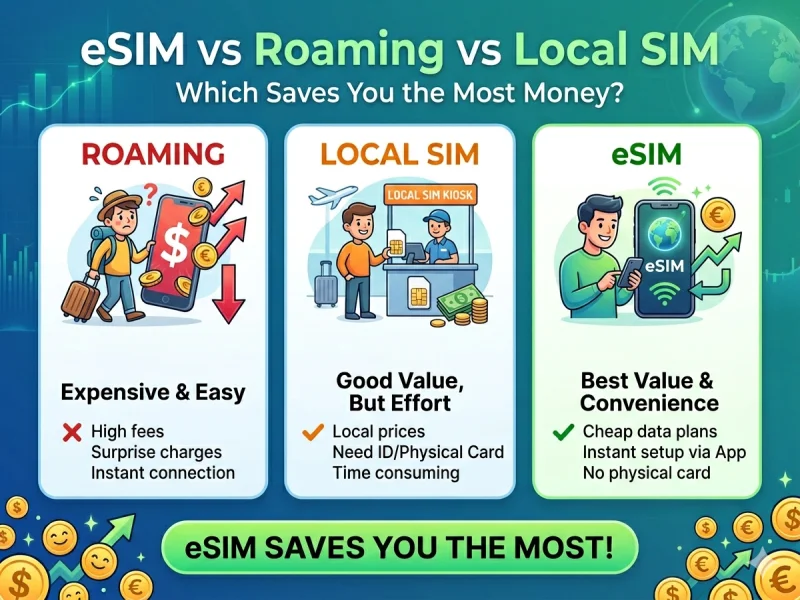
The short answer: For most international trips over 3 days, a travel eSIM saves you the most money — often 80–90% less than carrier roaming. But the right choice depends on where you're going, how long you're staying, and what your phone supports. This guide gives you the real numbers so you can decide.
Picture this. You land in Tokyo after a 12-hour flight, turn off airplane mode, and your phone buzzes: "Welcome to Japan! International roaming charges now apply." Three days later you check your bill. $280. For checking Google Maps and sending a few WhatsApp messages.
This happens to millions of travellers every year. In 2024 alone, travellers worldwide racked up over $60 billion in unexpected roaming charges. The fix is simple — but only if you understand your options before you fly.
In 2026, you have three main ways to stay connected abroad: your carrier's roaming plan, a local SIM card you buy at your destination, or a travel eSIM you install before you fly. Each has a different cost, a different setup process, and suits different types of travellers. Here's the complete comparison — with real pricing, real destination breakdowns, and a clear verdict for every situation.
🌍 Skip the roaming bill. Get Tourist eSIM from $1.91.
200+ countries · Instant QR delivery · 4G/5G · Activates when you land
Browse Plans →📡 Option 1: Carrier Roaming — The Most Expensive Choice
Roaming is what happens when you do nothing. Your phone automatically connects to a foreign network through your home carrier's partnership agreements, and you pay their international rates. It's the most convenient option — but convenience comes with a steep price.
Without any international plan activated, pay-per-use roaming rates are extreme. US carriers charge up to $2.05 per MB — meaning a single MB costs over $2. Sending a 3MB photo on WhatsApp costs $6.15. Watching one hour of YouTube would theoretically cost over $2,000.
Most travellers activate a daily pass or international plan to avoid this, but even day passes add up fast:
👉 Swipe left to see all on mobile
| Carrier | Day Pass Cost | 7-Day Trip | 14-Day Trip | Data Per Day |
|---|---|---|---|---|
| AT&T (US) | $12/day | $84 | $168 | Domestic plan allowance |
| Verizon (US) | $12/day | $84 | $168 | Up to 2GB then throttled |
| T-Mobile (US) | Free (limited) | Free / $15/day | Free / $15/day | 256kbps free / full speed paid |
| EE (UK) | £2.00–£5.99/day | £14–£42 | £28–£84 | Varies by plan |
| Vodafone (UK) | £2.00–£7.86/day | £14–£55 | £28–£110 | Varies by zone |
| EU carriers (outside EU) | €0.99–€1.49/MB | Unpredictable | Can exceed €500 | No day pass — per MB |
⚠️ The hidden danger of roaming: Background app activity still uses data even when you're not actively browsing. iOS updates, iCloud backups, Instagram auto-loading, and Google Maps satellite tiles all consume data silently. At $2.05/MB, a single automatic iOS update could theoretically cost thousands of dollars. Always turn off background app refresh AND data roaming on your home SIM when using a travel eSIM or local SIM abroad.
When roaming actually makes sense
Roaming is only worth it for very short trips (1–2 days) where the setup time of an eSIM or local SIM isn't worth it, or if your carrier includes free international data (T-Mobile Go5G, Google Fi). For anything longer, you'll save money with an alternative.
🪪 Option 2: Local SIM Card — Cheap but Inconvenient
Buying a SIM card at your destination is often the cheapest option per GB — but it comes with a stack of real-world friction that most travellers underestimate.
The process: land at the airport, find the SIM kiosk (it may be closed if you arrive late at night), queue up, show your passport, communicate your plan requirements in possibly a foreign language, pay in local cash or card, then physically swap out your SIM — removing your home SIM and storing it somewhere you won't lose it — then set up the new SIM on your phone. Then do it all again at every new country you visit.
Real local SIM prices by destination (2026)
👉 Swipe left to see all on mobile
| Destination | Local SIM Cost | Data Included | Where to Buy | Key Hassle |
|---|---|---|---|---|
| 🇯🇵 Japan | ¥3,000–¥5,000 (~$20–$37) | 5GB–Unlimited / 7–30 days | Airport kiosk, electronics stores | Data-only (no calls), kiosks close late |
| 🇹🇭 Thailand | 299–1199 THB (~$9–$37) | 15GB–Unlimited / 8–30 days | Airport, 7-Eleven, AIS/True stores | Must swap SIM, lose home number |
| 🇺🇸 USA | $20–$60 | Varies widely by carrier | AT&T/T-Mobile stores, Walmart | Requires in-store visit, ID check |
| 🇬🇧 UK | £5–£20 | 1GB–Unlimited / 30 days | EE/O2/Three stores, Tesco, Argos | Good value but requires in-person visit |
| 🇦🇪 UAE / 🇶🇦 Qatar | AED 50–200 (~$14–$54) | 5GB–40GB / 7–30 days | Airport, Etisalat/Du stores | Passport registration required |
The real problems with local SIMs
|
✓ PROS
|
✗ CONS
|
🚨 The banking problem nobody warns you about: When you remove your home SIM to insert a local SIM, your bank's SMS verification codes (2FA) go to a number that's no longer in your phone. This can lock you out of mobile banking apps at exactly the moment you need them most — abroad. An eSIM avoids this completely because your home SIM stays in your phone alongside it.
📲 Option 3: Travel eSIM — Best of Both Worlds
A travel eSIM is a digital SIM card built into your phone that you activate via a QR code. It gives you local data rates like a local SIM — but without any of the physical inconvenience. And because it runs alongside your home SIM (not instead of it), you keep your home number active the entire time.
The process: buy online, receive a QR code by email within seconds, scan it in your phone settings before you fly, and when your plane lands — you're online. No queues. No kiosks. No SIM swapping. No language barriers.
💡 How the dual SIM setup works: Your phone has two active lines simultaneously. Line 1: your home SIM — handles calls and SMS (including 2FA texts from your bank). Line 2: Tourist eSIM — handles all mobile data at local rates. You set Tourist eSIM as the default data line in settings, and your home SIM stays on for calls and texts. Both work in parallel. No juggling. No swapping.
Tourist eSIM prices vs roaming vs local SIM — same destination
👉 Swipe left on mobile to see all
| Destination & Trip | Tourist eSIM ⭐ | Carrier Roaming | Local SIM | Your Saving vs Roaming |
|---|---|---|---|---|
| 🇯🇵 Japan · 10 days · 10GB | ~$12–18 | $120 (AT&T/Verizon) | ~$22–37 | Save ~$100 |
| 🇹🇭 Thailand · 14 days · 15GB | ~$15–22 | $168 (AT&T/Verizon) | ~$9–14 | Save ~$145 |
| 🇺🇸 USA · 7 days · 10GB | ~$14–20 | $84 (AT&T/Verizon) | ~$20–60 | Save ~$65 |
| 🌍 Europe · 14 days · 15GB | ~$20–35 | £42–£84 (EE/Vodafone UK) | ~£5–20 per country | Save ~£50–65 |
| 🌏 Asia multi-country · 21 days | ~$25–40 | $252 (AT&T/Verizon) | $40–80 total (3 SIMs) | Save ~$210 |
|
✓ PROS of Travel eSIM
|
✗ CONS of Travel eSIM
|
Save up to 90% vs roaming. Tourist eSIM from $1.91.
Japan, Thailand, USA, Europe + 200 more countries · QR code in seconds
Get Your eSIM →🗺️ Destination-by-Destination Verdict
Japan's local SIM cards are data-only (Japanese regulations make voice tourist SIMs rare), so you lose your home number for calls regardless of which option you choose. That removes local SIM's main advantage. A Tourist eSIM for Japan starts from ~$2 and delivers 4G/5G speeds on NTT Docomo, SoftBank, and KDDI networks. You're online before you reach baggage reclaim at Narita or Haneda.
Roaming cost (AT&T/Verizon, 10 days): ~$120 | Local SIM (airport, 10GB): ~$22–37 | Tourist eSIM (10GB): ~$12–18
Thailand is one of the easier countries to buy a local SIM — AIS, DTAC, and True Move H kiosks are at every international airport and 7-Eleven. Plans start from 299 THB (~$9). However, buying a local SIM means removing your home SIM and losing your home number. If you need banking SMS or WhatsApp notifications on your usual number, go eSIM. If you're staying long-term or want the cheapest option and don't need your home number — local SIM wins slightly on price.
Roaming (14 days): ~$168 | Local SIM (AIS, 15 days): ~$13 | Tourist eSIM (15GB): ~$15–20
US carrier roaming from international carriers is very expensive — EE UK customers pay £5.99/day outside Europe, while most European carriers charge per MB at extreme rates. Local US SIMs require visiting an AT&T or T-Mobile store with ID (which can take hours). A Tourist eSIM is by far the fastest, cheapest option for international visitors — delivered instantly, works on T-Mobile/AT&T networks, and keeps your home number active for calls.
Roaming (7 days, EE UK): ~£42 | Local SIM (in-store): $20–60 + hassle | Tourist eSIM: from $2.04
For EU residents, "Roam Like at Home" covers all 27 EU member states for free — so if you're an EU citizen travelling within the EU, use your home SIM. But for US, UK, Canadian, or other non-EU visitors, Europe is expensive for roaming. A Tourist eSIM Europe plan covers 30+ countries with one purchase — no buying a new SIM every time you cross a border from France to Italy to Spain.
EU roaming (US carriers, 14 days): $168 | Local SIM per country: £5–20 each | Tourist eSIM (30+ countries): from $1.98
🎯 The Final Verdict — Which Should You Choose?
👉 Swipe left to see all on mobile
| Your situation | Best choice | Why |
|---|---|---|
| Short trip (1–2 days), lazy | Roaming | Zero setup for very short stays — but watch background data |
| Trip of 3–30 days, any destination | 🏆 Tourist eSIM | Cheapest, fastest, keeps home number active |
| Multi-country trip (3+ countries) | 🏆 Tourist eSIM regional | One plan auto-switches across borders |
| Long stay (1 month+) in one country | Local SIM | Cheapest per GB for extended stays |
| Need banking / 2FA SMS while abroad | 🏆 Tourist eSIM | Home SIM stays active for verification texts |
| EU citizen travelling within EU | Home SIM (free) | Roam Like at Home — use your home plan for free |
| Non-EU visiting Europe | 🏆 Tourist eSIM | Roam Like at Home doesn't apply to you |
| Phone is not eSIM-compatible | Local SIM | eSIM requires iPhone XS+ or Android equivalent |
| Business travel — need calls + data | 🏆 Tourist eSIM (DVS) | Tourist eSIM's Data+Voice+SMS plans — unique in the market |
⚙️ How to Set Up Tourist eSIM in 3 Steps
Go to touristesim.net/coverage, pick your destination or regional plan. Your QR code arrives by email within seconds. No app required.
iPhone: Settings → Cellular → Add eSIM → Use QR Code → scan. Android: Settings → Connections → SIM Manager → Add eSIM → scan. Takes about 60 seconds on home Wi-Fi.
When you land, go to your phone settings and set Tourist eSIM as your default data line. Turn on Data Roaming for the Tourist eSIM line. Turn off Data Roaming on your home SIM. You're online before you reach customs.
💡 Pro tip: Label your Tourist eSIM in settings — for example "Japan Trip 2026" — so you can always tell which line is which. And keep your home SIM's Data Roaming switched OFF to guarantee there are no accidental home-carrier charges.
❓ Frequently Asked Questions
Is a travel eSIM cheaper than roaming?
Almost always, yes — often by 80–90%. AT&T and Verizon charge $12/day, meaning a 10-day Japan trip costs $120 just in daily fees. A Tourist eSIM for Japan starts from around $12–18 total for 10GB. The savings are substantial on any trip longer than 2–3 days.
Is a local SIM cheaper than a travel eSIM?
Sometimes marginally, for long stays in one country. In Thailand, a local AIS SIM for 8 days costs ~$9 — slightly cheaper than an eSIM equivalent. But a local SIM means removing your home SIM (losing your phone number and banking 2FA), queuing at the airport, and buying a new SIM at every destination. For multi-country trips, eSIM is much more convenient and often cheaper overall.
Will my bank's 2FA still work with an eSIM?
Yes — this is one of the biggest advantages of eSIM over local SIM. With a Tourist eSIM, your home SIM stays in your phone active for calls and SMS. Your bank's verification texts go to your usual number as normal. With a local SIM, your home SIM is removed, which can lock you out of banking apps that verify via SMS.
Does EU "Roam Like at Home" make eSIM unnecessary for Europeans?
Only within the EU. EU residents can use their home SIM across all 27 EU member states for free. But Japan, Thailand, USA, UAE, Turkey, and any country outside the EU still charges full international rates. Post-Brexit UK residents are also now charged for EU roaming by most carriers (except O2). For any trip outside the EU, a travel eSIM saves money.
How do I check if my phone supports eSIM?
On iPhone: Settings → General → About → scroll down. If you see an EID number, your phone supports eSIM. On Android: Settings → About Phone → look for EID. Most iPhones from XS (2018) onwards support eSIM, as do most Samsung Galaxy S20+, Google Pixel 3+, and many other modern flagships. Check the full list at touristesim.net/esim-compatible-phones.
Can I use a travel eSIM across multiple countries?
Yes. Tourist eSIM's regional plans cover multiple countries on one eSIM — for example, the Asia plan covers Japan, Thailand, South Korea, Vietnam, and more. The eSIM connects to the best available local network automatically as you cross borders. No reinstalling, no buying new plans at each country, no airport kiosk queues.
What's the fastest way to get connected after landing?
A travel eSIM installed before your flight. When you turn off airplane mode on landing, your Tourist eSIM connects to the local network automatically. You're online before you leave the aircraft — no queues, no kiosks, no SIM swapping. This also means your navigation, Uber, and hotel directions are all ready from the moment you need them.
🌍 Stop paying €10/day for roaming. Get Tourist eSIM.
200+ countries · From $1.91 · Data + Voice + SMS plans available · Instant QR delivery · No hidden fees
Browse All Plans →Also explore: Japan eSIM · Thailand eSIM · USA eSIM · Europe eSIM · Asia eSIM




Comments